
Top Signs You Need Garage Door Service – Don’t Ignore These
A garage door that’s slow to open isn’t necessarily a sign of a worn motor. More often it’s a cable starting to unspool from its drum – a small repair today, a bent track and a damaged panel if it finishes unspooling mid-cycle. The signs that actually matter are component-specific, not vague. Here’s how to read what your door is telling you before a cheap fix turns into an expensive one. If you’d rather not DIY, call (833) 482-6529.
The Signs That Actually Matter (And What They Mean)
Most “warning signs” lists stop at slow operation and unusual noise. That’s not actionable. A grinding sound means something different from a squeal, and a torsion spring with a visible gap isn’t about to break – it’s already broken. Knowing which symptom points to which component changes your timeline from “schedule service when convenient” to “don’t touch the door.”
We work on Garage Door Repair Squirrel Hill equipment every week, and the pattern is consistent: the homeowners who catch a problem early are reading specific symptoms, not general ones. Here’s what to look and listen for:
- A visible gap in a torsion spring – the spring has already failed. Stop using the door.
- A cable off its drum – the door can drop or rack out of square on the next cycle.
- Grinding, squealing, or popping from the rollers – each points to a different fix.
- One side lifting faster than the other – a cable or spring on that side is failing.
- The door reversing at the wrong point – a sensor or travel-limit fault, not a motor fault.
In Squirrel Hill’s older homes, doors often run on original hardware that’s been adjusted many times. Those adjustments can mask a failing component until it lets go. Reading symptoms early is how you avoid that.
How to Inspect Torsion Springs: Gap vs. Stress Fracture
A torsion spring with a visible gap between its coils is already broken, not about to break. That’s the single most important distinction on this list. A spring with a stress fracture or a hairline crack is still holding tension but is compromised. The two demand different responses: a broken spring means stop using the door, a fractured one means schedule service before it fails.
Here’s how to tell them apart without touching anything:
- Look at the spring above the door (or above the track on a torsion system). A clean gap between coil sections means it’s broken.
- Check for a winding cone that’s shifted away from the spring body – a sign the spring has unwound.
- Look for rust-colored dust or a visible crack along a coil – that’s a stress fracture still under tension.
- Never try to wind, unwind, or “test” a torsion spring yourself. These springs store enormous energy and can cause serious injury. This is a job for a trained technician.
Spring repair is its own discipline. That’s why we handle it as a dedicated service rather than folding it into general repair – high-tension work needs the right tools and the right training. If you’re in Squirrel Hill and see a gap, don’t run the door. Call us and we’ll get a technician out to assess it.
Roller Wear: Grinding, Squealing, or Popping?
The sound your door makes tells you which fix you need. Grinding usually means a metal roller has worn flat or a bearing has seized – you need nylon roller replacement. Squealing typically means dry hinges or a dry track – lubrication will quiet it. Popping often means a roller is jumping its track or a panel is binding – that’s a track realignment, not a lubrication job.
Roller wear is one of the most common issues we see on doors using Clopay and Amarr hardware in Squirrel Hill, especially on doors that run several times a day. Nylon rollers wear more quietly than metal ones, but they still wear. A few things to check:
- Run your hand along the track (door closed, power off). Grit or metal shavings mean a roller is grinding.
- Look at each roller for flat spots, cracks, or a bearing that wobbles.
- Listen at the start and end of travel – popping at those points usually signals a track or panel issue, not a roller.
A slow roller or a dry hinge is a do-it-yourself job for a careful homeowner. A popped roller or a binding panel isn’t – that’s when you call a pro. Our technicians have up to 10 years of experience reading exactly these symptoms.
The 60-Second Photo Eye Test
A blinking indicator light on a photo eye means the sensor isn’t receiving a clear signal – usually misalignment, dirt, or a wiring fault. A solid light means the sensor is aligned and working. You can run this test in about a minute, and it’s the first thing to check when a door won’t close.
Here’s the test:
- Find the two photo eyes mounted near the floor on each side of the door.
- Look at the indicator light on each one – one is usually the sender, one the receiver.
- If one blinks and the other is solid, the sensors aren’t talking. Wipe the lenses, check for an obstruction, and confirm both are pointed at each other.
- If both are dark, check the wiring or the opener’s power.
We work on Genie and LiftMaster opener systems specifically, and photo eye faults are one of the most common “the door won’t close” calls we get in Squirrel Hill. Sometimes it’s a spiderweb. Sometimes it’s a sensor that’s drifted out of alignment. The test tells you which.
If the sensors are aligned and the door still won’t close, that’s a garage door opener repair issue – a travel limit, a logic board, or a wiring fault – and it needs a technician.
Uneven Door Movement: What One Side Is Telling You
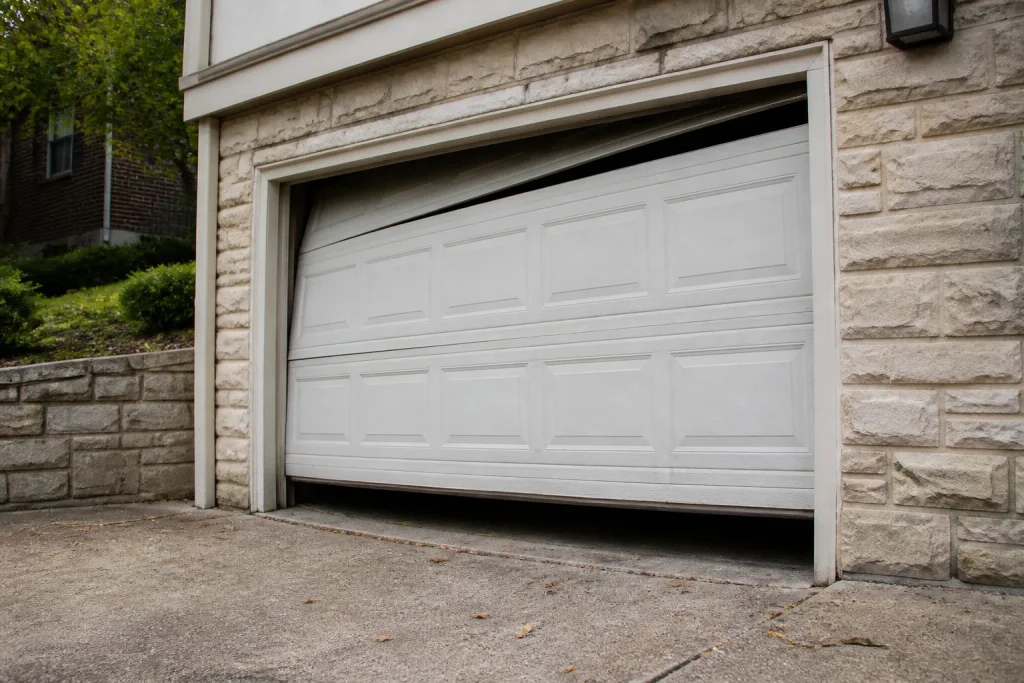
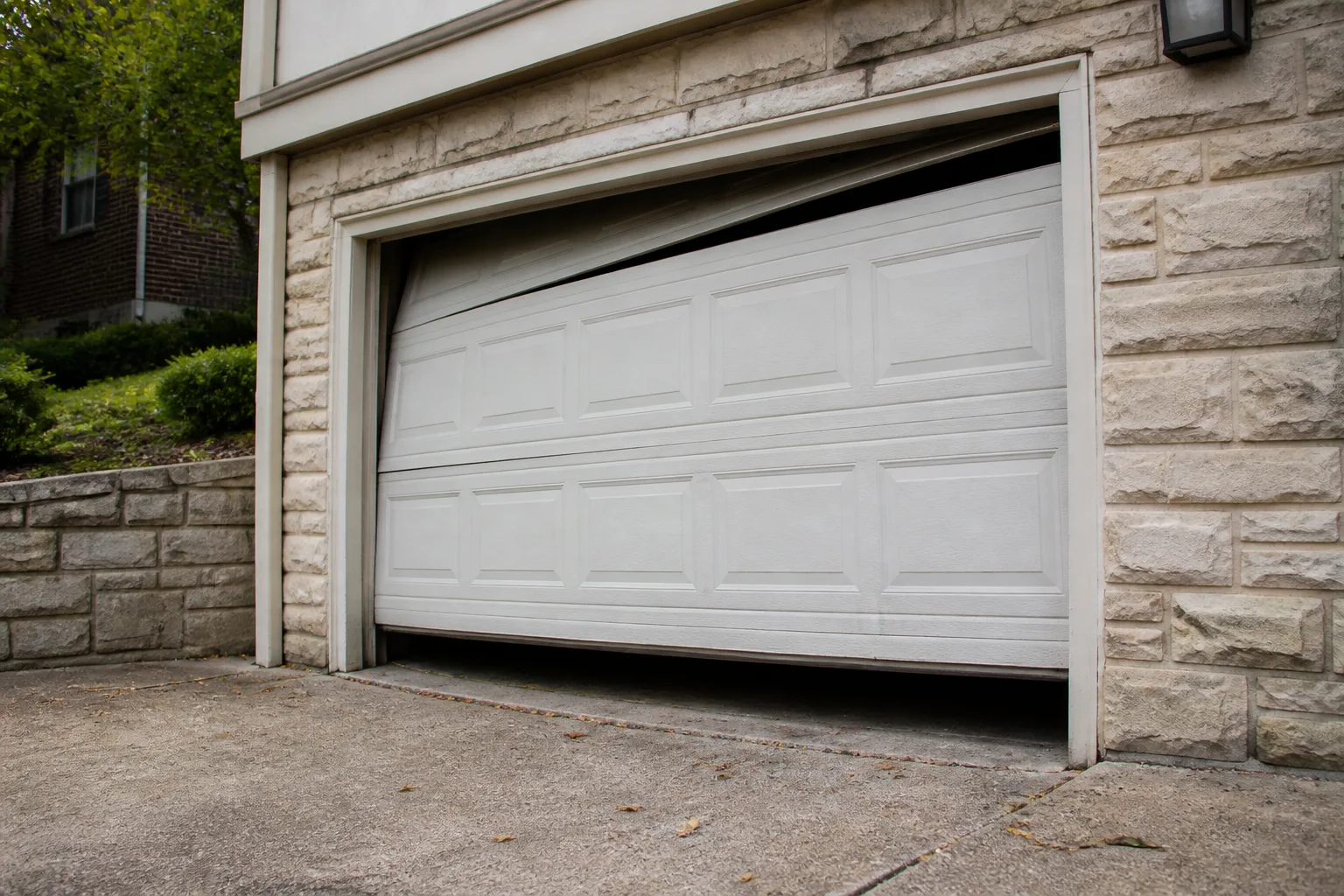
A door that lifts faster on one side than the other points to a failing cable or spring on that side – not a motor problem. The door is racking because the lifting force isn’t balanced. Left alone, that imbalance bends tracks, cracks panels, and can drop the door. This is a stop-and-call symptom, not a “wait and see” one.
Here’s what uneven movement usually means:
- One side rises first, then the other catches up – a stretched or slipping cable on the lagging side.
- The door looks crooked when closed – a spring on one side has lost tension.
- A cable looks loose or is off its drum – stop using the door. This can let the door drop.
Cables and springs work as a system. Replacing one without checking the other is how a repair comes back. We check both sides on every spring or cable job – that’s standard practice for us, not an upsell. In Squirrel Hill, where many doors are older and have been adjusted repeatedly, uneven movement is one of the clearest early warnings you’ll get.
Opener Reversal Behavior: Early vs. Late
A door that reverses immediately on closing points to a photo eye or safety sensor fault. A door that reverses after traveling halfway down points to a travel limit, force setting, or logic board issue. Same symptom, different diagnosis – and one is a sensor fix while the other is an opener repair.
Here’s how to read it:
- Reverses immediately – check photo eyes first (see the 60-second test above). If they’re clear and aligned, the opener’s safety circuit needs attention.
- Reverses halfway down – the opener’s travel limit or force setting is off, or the door is binding on one side and the opener is detecting resistance.
- Reverses and the light blinks a code – the opener is telling you what’s wrong. Count the blinks and note the brand – Genie, Chamberlain, and LiftMaster each use their own code patterns.
We’re brand-familiar, not brand-guessing. Chamberlain Group products (LiftMaster, Chamberlain, Craftsman) and independent lines like Genie and Wayne Dalton each have their own quirks. Knowing those quirks is the difference between a quick fix and a return visit.
When to Call a Pro
Call a pro when you see a spring gap, a cable off its drum, uneven door movement, or a door that reverses at the wrong point and won’t correct after a photo eye check. Those are the symptoms where a homeowner-run fix can cause injury or turn a small repair into a large one.
Springs and cables are the two things you should never adjust yourself – the stored energy is genuinely dangerous. Track realignment and opener logic faults are also technician territory. Everything else (lubrication, roller swaps, photo eye cleaning) is reasonable to handle yourself if you’re careful.
If you’re in Squirrel Hill and need help, we offer free estimates and can work with your insurer where relevant. Call (833) 482-6529. We answer 24/7. Fast dispatch from 7am to 7pm, Sunday through Friday.
Related services in Squirrel Hill: garage door repair, garage door opener repair, and garage door installation.
The Bottom Line
The signs that matter are component-specific. A spring gap means stop using the door. A cable off its drum means call now. Grinding, squealing, and popping each point to a different roller fix. A blinking photo eye is a sensor issue; a door that reverses halfway down is an opener issue. And uneven movement means one side is failing before the whole system does.
Read the symptoms, act on the urgent ones, and don’t run a door with a broken spring or a loose cable. If you’re in Squirrel Hill and need help, Garage Door Repair Squirrel Hill offers free estimates – call (833) 482-6529. We answer 24/7. Fast dispatch from 7am to 7pm, Sunday through Friday, and we’re closed Saturday.
Frequently Asked Questions
A visible gap between the coils means the spring is already broken. A hairline crack or rust dust along a coil means it’s fractured but still under tension – schedule service before it fails. Don’t run the door in either case, and don’t try to test the spring yourself. Call (833) 482-6529 for an assessment.
A door that reverses halfway down usually has a travel limit or force setting issue, or it’s binding on one side. A door that reverses immediately points to a photo eye or safety sensor fault. Check the photo eyes first with the 60-second test, then call for opener repair if the issue persists. Call (833) 482-6529 for a free estimate.
A blinking indicator light means the sensor isn’t receiving a clear signal – usually misalignment, dirt, or a wiring fault. A solid light means it’s aligned and working. Wipe the lenses and check alignment first; if it still blinks, it’s a sensor or wiring repair. Call (833) 482-6529 if you need help.
Yes, for a slow or noisy roller – lubrication or a nylon roller swap is a reasonable DIY job. But a popped roller, a binding panel, or a door that’s come off its track needs a technician. If you’re unsure which you have, call (833) 482-6529 and we’ll talk it through.
Written by the team at Garage Door Repair Squirrel Hill.
Need Garage Door Help?
Call Garage Door Repair Squirrel Hill - the local pro we connect you with is licensed and insured, here with fast help in Squirrel Hill.
(833) 482-6529